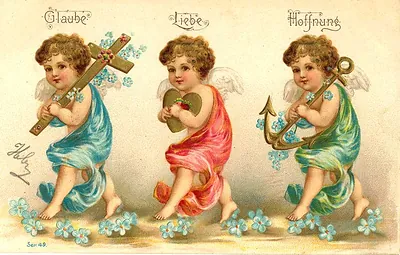
Three cherubs carrying cross, heart and anchor, Glaube Liebe Hoffnung – Historic Print

(Each image is professionally and digitally cleaned of artifacts such as color bars and extra borders prior to printing.)
Description
This historic image of Three cherubs carrying cross, heart and anchor, Glaube Liebe Hoffnung brings a moment of history to your wall. It is part of the Snapshots of the Past archive, gathered over 25 years of research.
Order it framed and ready to hang, or unframed to match a frame you already love. Perfect for a home, office, library or classroom wall, and a gift with a story behind it. Free shipping in the lower 48 states. Snapshots of the Past has been bringing history to the wall since 2001, for tens of thousands of customers worldwide.
Three cherubs carrying cross, heart and anchor, Glaube Liebe Hoffnung
Order a print
Thank you. Your order went through, and a receipt is on its way by email.
Secure checkout · SSL encryptedPowered by Stripe and PayPal
Free shipping in the lower 48 states. The checkout page shows the picture, size and price before you pay.
Three winged cherubs, each carrying one emblem, set this picture apart on the board: a cross for faith, a heart for love and an anchor for hope, with the German words *Glaube, Liebe, Hoffnung* lettered beneath. The trio draws on 1 Corinthians 13:13, where Paul names faith, hope and love as the enduring virtues, while the anchor echoes Hebrews 6:19, which describes hope as an anchor of the soul. Devotional pictures like this circulated widely in German-speaking Christian households, where playful putti offered a gentle way to teach children these core virtues. The combination of image and text is worth noticing, since each symbol is paired with its German name.
| Original scan | 944 × 630 px |
|---|---|
| Reference | Angels079 |
More from the Religious collection
Snapshots of the Past helps heritage brands, museums, historians and storytellers tell stories with history: historic prints, image licensing and historical storytelling drawn from more than 25 years of research and curation.