Proposed line of rail roads and hotels – Vintage Wall Art

(Each image is professionally and digitally cleaned of artifacts such as color bars and extra borders prior to printing.)
Description
This historic image of Proposed line of rail roads and hotels brings a moment of history to your wall. It is part of the Snapshots of the Past archive, gathered over 25 years of research.
Order it framed and ready to hang, or unframed to match a frame you already love. It makes a striking addition to a living room, study or office, and a thoughtful gift. Free shipping in the lower 48 states. Since 2001, Snapshots of the Past has shipped historic prints to tens of thousands of customers around the world.
Proposed line of rail roads and hotels
Order a print
Thank you. Your order went through, and a receipt is on its way by email.
Secure checkout · SSL encryptedPowered by Stripe and PayPal
Free shipping in the lower 48 states. The checkout page shows the picture, size and price before you pay.
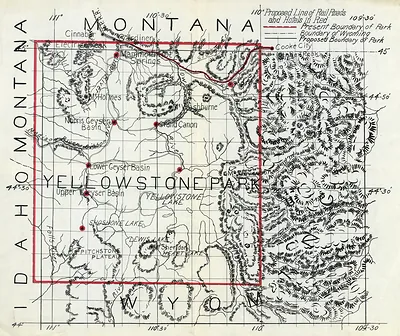
Few parts of the park's history are as tangled as the question of how visitors should reach its interior, and this 1912 map shows one of the schemes that was debated during those years. It sketches routes for rail lines and hotel sites across the plateau, at a time when the park had been set aside in 1872 but still had only rough roads and stagecoaches. Railroads had already reached the park's northern and western gateways, and the question of extending tracks inside the boundaries pitted tourism promoters against those who wanted the land kept wild. The map is a useful record of how far those ambitions reached before the 1916 act created the National Park Service and set limits on development.
| Created / published | 1912 |
|---|---|
| Original scan | 3,750 × 3,152 px · prints to 12 × 11 in at 300 dpi |
| Reference | Proposed line of rail roads and hotels 1912 |
More from the Yellowstone collection
Snapshots of the Past helps heritage brands, museums, historians and storytellers tell stories with history: historic prints, image licensing and historical storytelling drawn from more than 25 years of research and curation.